
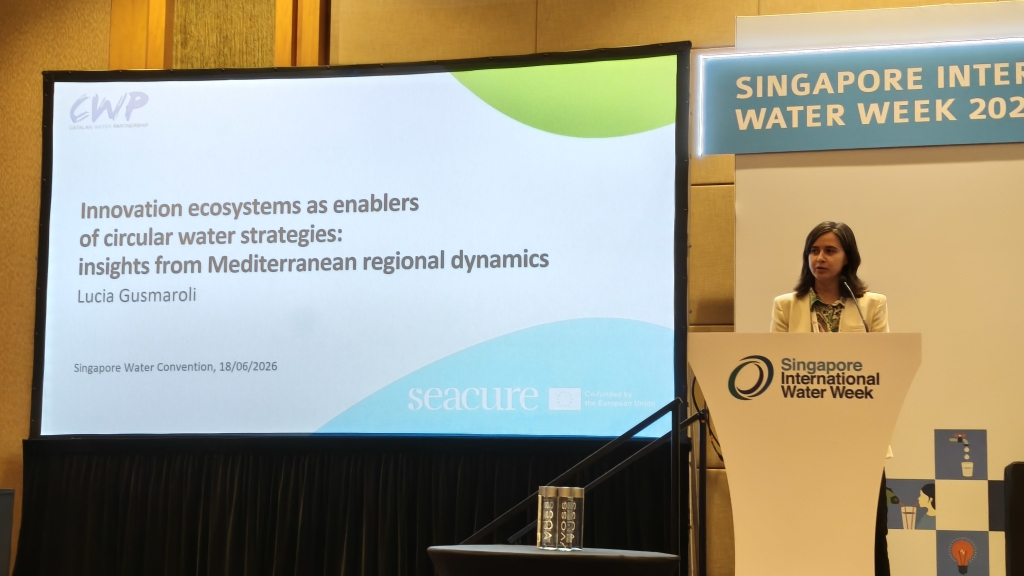
From 15 to 18 June, the Catalan Water Partnership brought SEACURE to the Singapore International Water Week 2026, a key meeting point for the global water community.

In a context where water resilience increasingly depends on how territories manage water resources, reduce pollution and balance competing environmental, social and economic needs, SEACURE contributed to Singapore International Water Week 2026 by bringing Mediterranean perspectives on how regional innovation ecosystems can help align knowledge, decision-making, resources and capacities to support healthier and more resilient water systems.

The Catalan Water Partnership (CWP) contributed to the conference programme during the Stakeholder Engagement session with a discussion around “Innovation ecosystems as enablers of circular water strategies: insights from Mediterranean regional dynamics.”  

The contribution showcased how SEACURE is working across Mediterranean regions to better understand the territorial conditions that can enable the uptake of innovative solutions to protect water systems from nutrient pollution.

Lucia Gusmaroli, European Projects and Internationalisation Area Manager (CWP), at Singapore International Water Week 2026

The discussion drew on the work led by CWP under SEACURE’s Strategic Orientation Analyses, which examined the regional innovation ecosystems of the project’s six basins and territorial units through a quantified SWOT approach. Beyond mapping strengths, weaknesses, opportunities and threats, the analysis provides a strategic reading of each territory’s capacity to address nutrient pollution, considering ecological, technical, socioeconomic and regulatory dimensions. 

The analysis points to a clear message: the Mediterranean demonstrator regions already build on a strong base of tested innovations, research capacities, stakeholder awareness and policy frameworks, but still face common barriers such as limited knowledge transfer, fragmented cooperation, difficulties in scaling up promising solutions, and uneven capacity to turn regulatory frameworks into coordinated action on the ground.

The session underlined that advancing towards zero pollution objectives requires more than technological innovation alone. It also depends on whether regional ecosystems can align actors, mandates, incentives and implementation capacities, creating the conditions for existing knowledge and innovations to be translated into coordinated and effective action at basin and territorial scale.

By making visible not only the solutions available, but also the conditions needed for their adoption, SEACURE helps frame regional innovation ecosystems as a practical lever for sustainable nutrient management and a more resilient land-river-sea system.

📌 Further reading: Explore the full deliverable, Strategic Orientation Analysis. Integrated result of the quantified SWOT analyses of the regional innovation ecosystems within the basins/territorial units to learn more about the barriers and strategic pathways identified by the project to accelerate the uptake and real-scale implementation of innovative solutions for sustainable nutrient management and pollution reduction.