
On 4 November 2026, ECOMONDO in Rimini, Italy, hosted the international event “From Source-to-Sea to Scale: Mediterranean Pathways for Water Resilience and the Ocean Pact”, bringing together representatives from European and Mediterranean institutions, regional and river basin authorities, research actors and innovation projects to advance dialogue on the future of water resilience and the sustainable blue economy in the region.
Against the backdrop of the European Water Resilience Strategy and the European Ocean Pact, the event explored the need for stronger integration between freshwater and marine policies and the role of innovation, territorial cooperation and investment in accelerating the deployment of solutions.
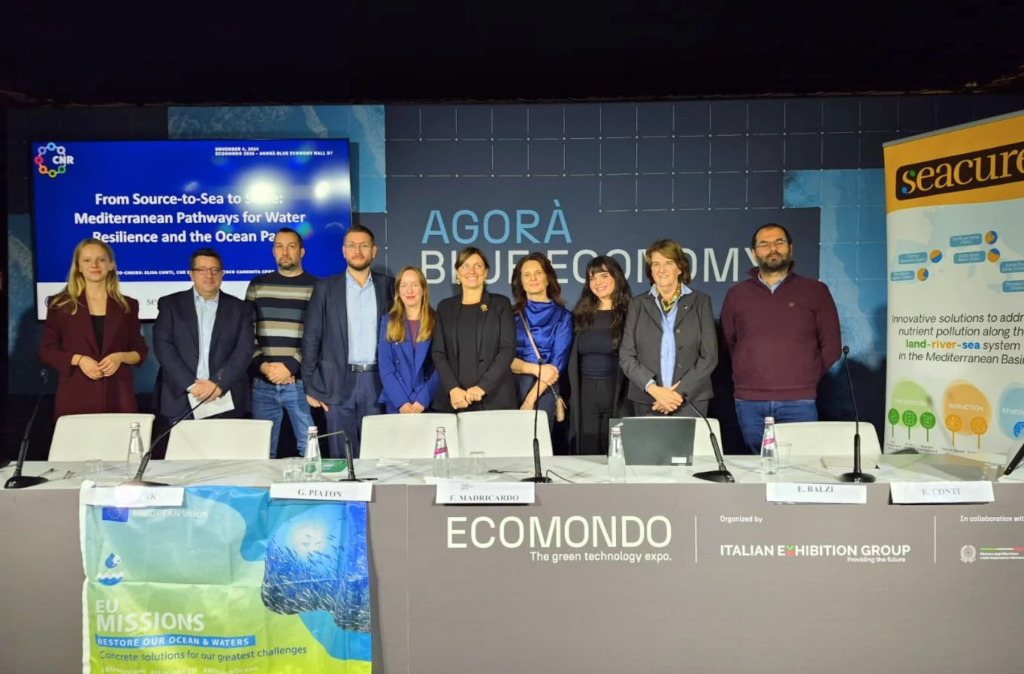
Co-chaired by Elisa Conti (CNR-DSSTTA) and Francesco Camonita (CPMR-IMC), the discussion followed a source-to-sea-to-scale approach, highlighting the Mediterranean’s potential to translate European policy ambitions into concrete, innovation-driven action, connecting freshwater management, marine ecosystem protection and territorial priorities to advance water resilience across the basin.
Co-organised by the National Research Council of Italy (CNR), the European Commission, the ECOMONDO Scientific Technical Committee, the CPMR Intermediterranean Commission and SEACURE, in collaboration with the Union for the Mediterranean (UfM), Interreg Euro-MED stakeholders and the BlueMissionMed legacy network, the event provided a platform for dialogue to reinforce synergies between European and Mediterranean priorities and explore key pathways towards more resilient aquatic ecosystems across the Mediterranean.
From the source: strengthening freshwater resilience and governance
The first session examined the policy priotrities, governance challenges and cooperation mechanisms shaping freshwater management and resilience in the Mediterranean.
Manuel Sapiano, Senior Expert at the Institut Méditerranéen de l’Eau (IME), opened the discussion with a Euro-Mediterranean perspective, drawing on the outcomes of the Euro-Mediterranean Water Forum held in Rome in September 2026 and the wider regional dialogue on water cooperation.
Representatives from Interreg programmes, Plan Bleu, the Emilia-Romagna and Veneto Regions, the Júcar River Basin Authority and the Mediterranean Network of Basin Organizations (MENBO) shared perspectives on water scarcity, climate adaptation and integrated water resources management, highlighting the need for stronger coordination across sectors, territories and levels of governance.
A recurring message was the importance of bridging European policy priorities with the realities faced by regional and local authorities. Rather than addressing freshwater and marine challenges separately, participants emphasised the value of coordinated approaches that recognise the connections between upstream water management and downstream ecosystems as part of a wider source-to-sea approach.
Towards the sea: from innovation to deployment
The second roundtable shifted attention towards the deployment and replication of innovative solutions, exploring how European policies and research initiatives can support their wider implementation. Institutional contributions from the European Commission and the Union for the Mediterranean provided perspectives on the evolving policy landscape and the opportunities for accelerating innovation uptake.
Christos Economou, Deputy Director for Maritime Policy and Blue Economy and Head of Unit for Sea Basin Strategies and Maritime Regional Cooperation at the European Commission’s DG MARE, addressed the European Ocean Pact and the forthcoming European Ocean Act, outlining the policy context for stronger ocean governance and sustainable blue economy development.
Bringing the Mediterranean cooperation perspective, Adriana Salazar, from the Union for the Mediterranean (UfM), connected European initiatives with the region’s shared priorities and the UfM framework for a sustainable blue economy.
These institutional perspectives were complemented by contributions from European research and innovation projects, including SEACURE, INSPIRE and BLUE ECOSYSTEM, illustrating how different initiatives are developing and testing solutions to address environmental challenges across Mediterranean territories.
A central message of the session was the importance of moving from successful innovation to effective implementation, a transition that requires not only technical evidence of effectiveness, but also appropriate governance conditions, stakeholder cooperation and stronger connections between research, policy and implementation.
Living Labs and collaborative innovation ecosystems
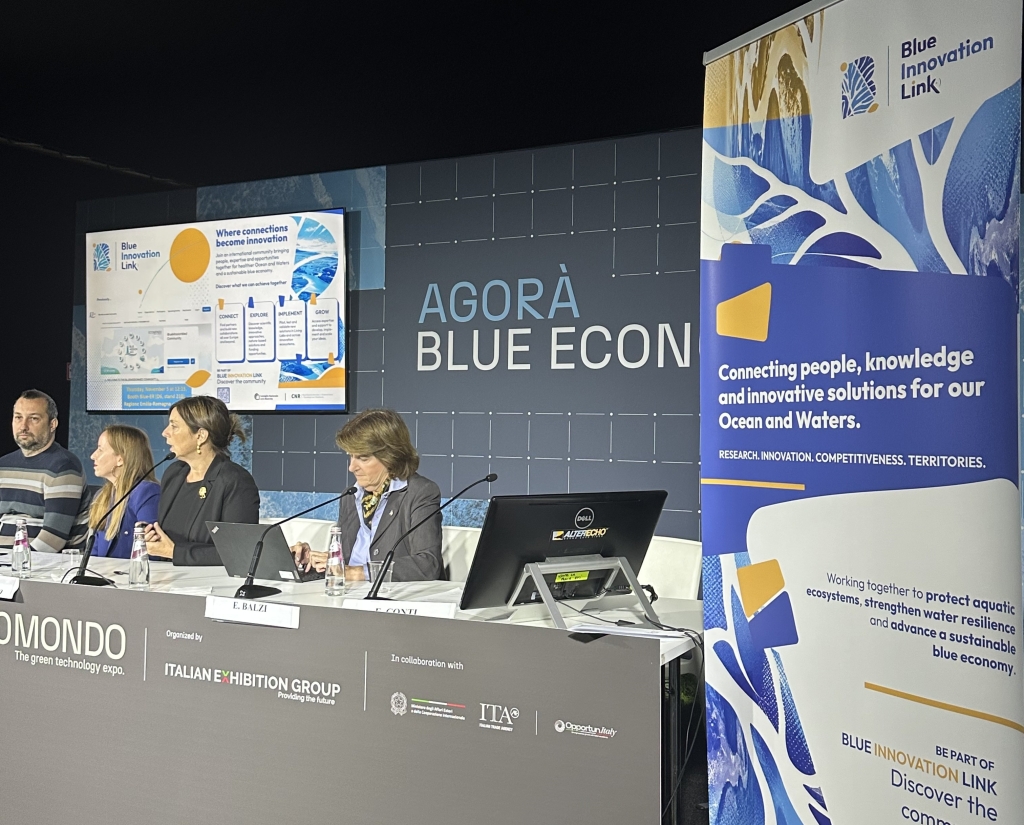
The final session, moderated by Elisabetta Balzi, Active Senior at the European Commission’s DG RTD, explored the role of Living Labs and collaborative innovation networks in facilitating the uptake and replication of solutions.
Contributions from CNR, the Cyprus Marine and Maritime Institute (CMMI) and the National Institute of Chemistry (Kemijski Inštitut) highlighted experiences from initiatives including BlueMissionMed, Blue Innovation Link, the Living Lab for Ocean and Waters, the Mediterranean Blue Living Lab Network, MEDCONNECT and REMEDIES 5.0.
Particular attention was given to the renewed Blue Innovation Link Community, building on the legacy of BlueMissionMed to strengthen connections between research organisations, policymakers, innovators, businesses and Mediterranean territories.
The session explored how co-creation, stakeholder participation and cross-regional knowledge exchange can help bridge the gap between innovation development and real-world implementation.
Living Labs provide an important setting for this process, bringing together different actors to identify needs, test approaches and adapt solutions to local conditions, while creating opportunities for replication across regions.
From shared priorities to collective action
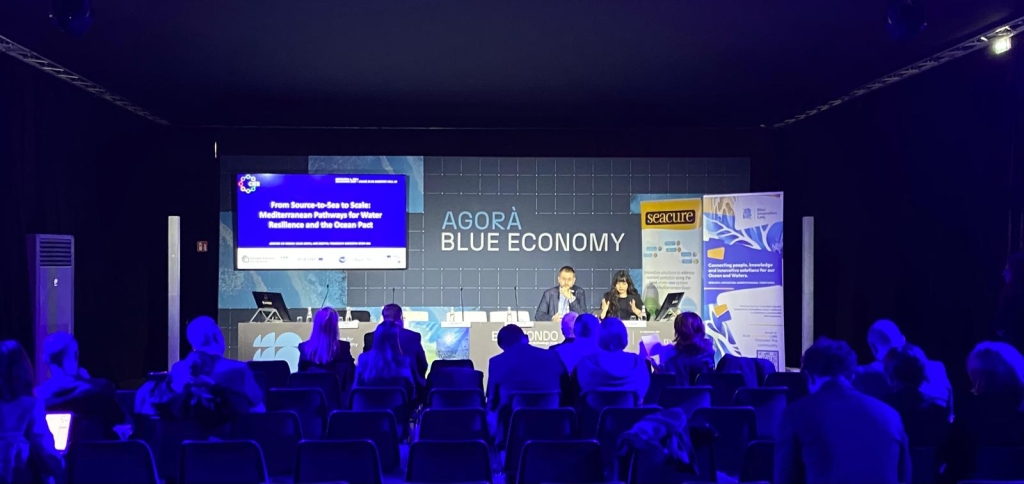
Across the three sessions, the event reinforced the need to treat water resilience, ecosystem protection and sustainable blue economy development as interconnected challenges requiring coordinated responses.
Three priorities emerged from the discussions:
- Strengthening policy coherence and multilevel governance, linking European strategies with Mediterranean, regional and local priorities and improving coordination across the source-to-sea continuum.
- Accelerating innovation uptake and replication, moving beyond successful pilot demonstrations towards solutions that can be implemented and adapted across different territories.
- Building stronger innovation ecosystems and partnerships, connecting research, public authorities, industry and communities through collaborative approaches that support long-term implementation.
The ECOMONDO discussions provided an opportunity to connect SEACURE efforts with broader European and Mediterranean initiatives, reinforcing the importance of cooperation between research, policymakers and the actors responsible for implementing solutions on the ground.
From source to sea to scale, the next challenge is to turn shared ambitions and tested solutions into lasting impact across the Mediterranean.