
SEACURE joined the Euro-Mediterranean Water Forum 2026 in Rome, bringing its source-to-sea perspective on nutrient pollution into the wider debate on how water resilience policies can translate into coordinated action across the Mediterranean.
Held at La Nuvola, the Euro-Mediterranean Water Forum provided an opportunity for the project to showcase its work at the Consiglio Nazionale delle Ricerche (CNR) exhibition space and to convene the dedicated session “From Policy to Practice: Scaling Nutrient Solutions across the Land–River–Sea Continuum” on 30 September.
The dedicated SEACURE session brought together representatives from the European Commission, regional authorities, research organisations, technology providers and practitioners to discuss a central challenge: how policy, governance and innovation can help effective nutrient-management solutions move from successful demonstrations towards wider implementation across the Mediterranean.
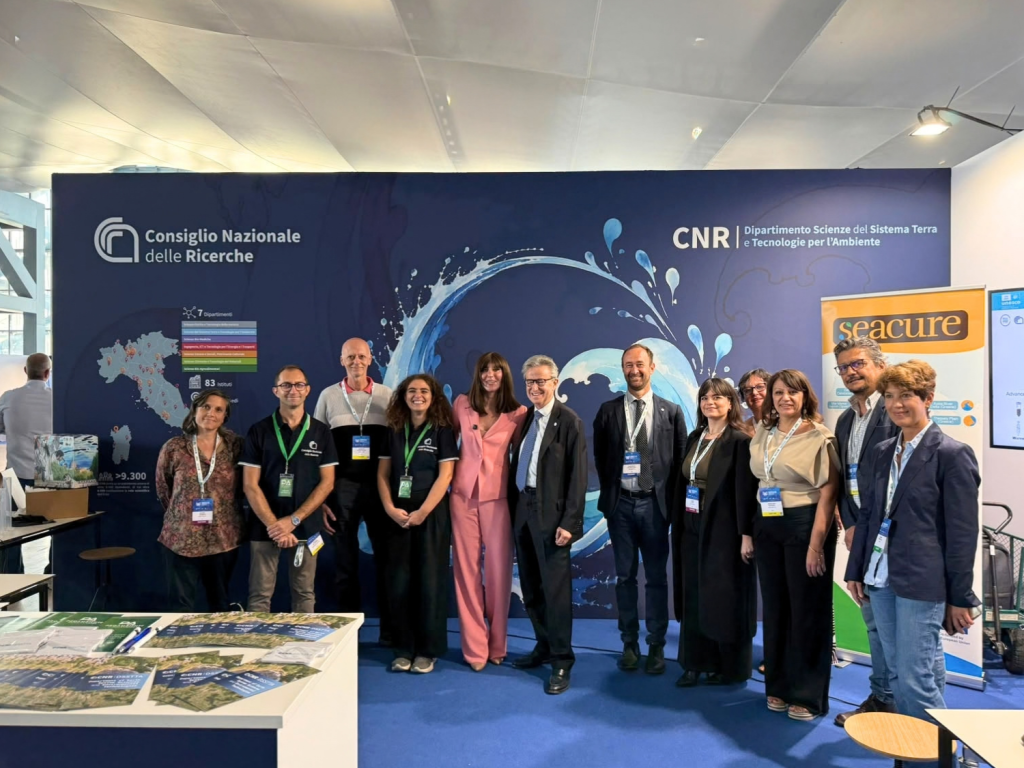
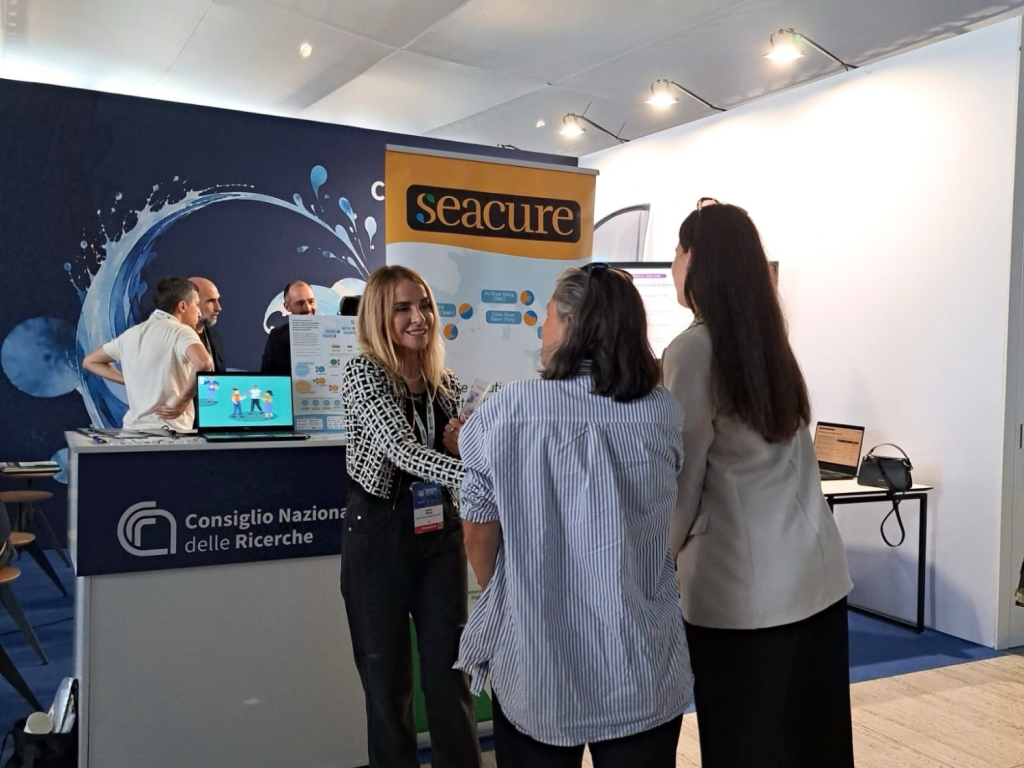
During the Forum, the SEACURE stand also had the pleasure of welcoming Andrea Lenzi, President of CNR, and Anna Maria Bernini, Italian Minister of University and Research, providing an opportunity to present the project’s approach and its work across Mediterranean territories.
From water resilience policy to implementation
The session, chaired by Elisa Conti, CNR DSSTTA, opened with a video message from Charlina Vitcheva, Director-General of DG MARE, European Commission, on the pathway from the European Ocean Pact towards the Ocean Act.
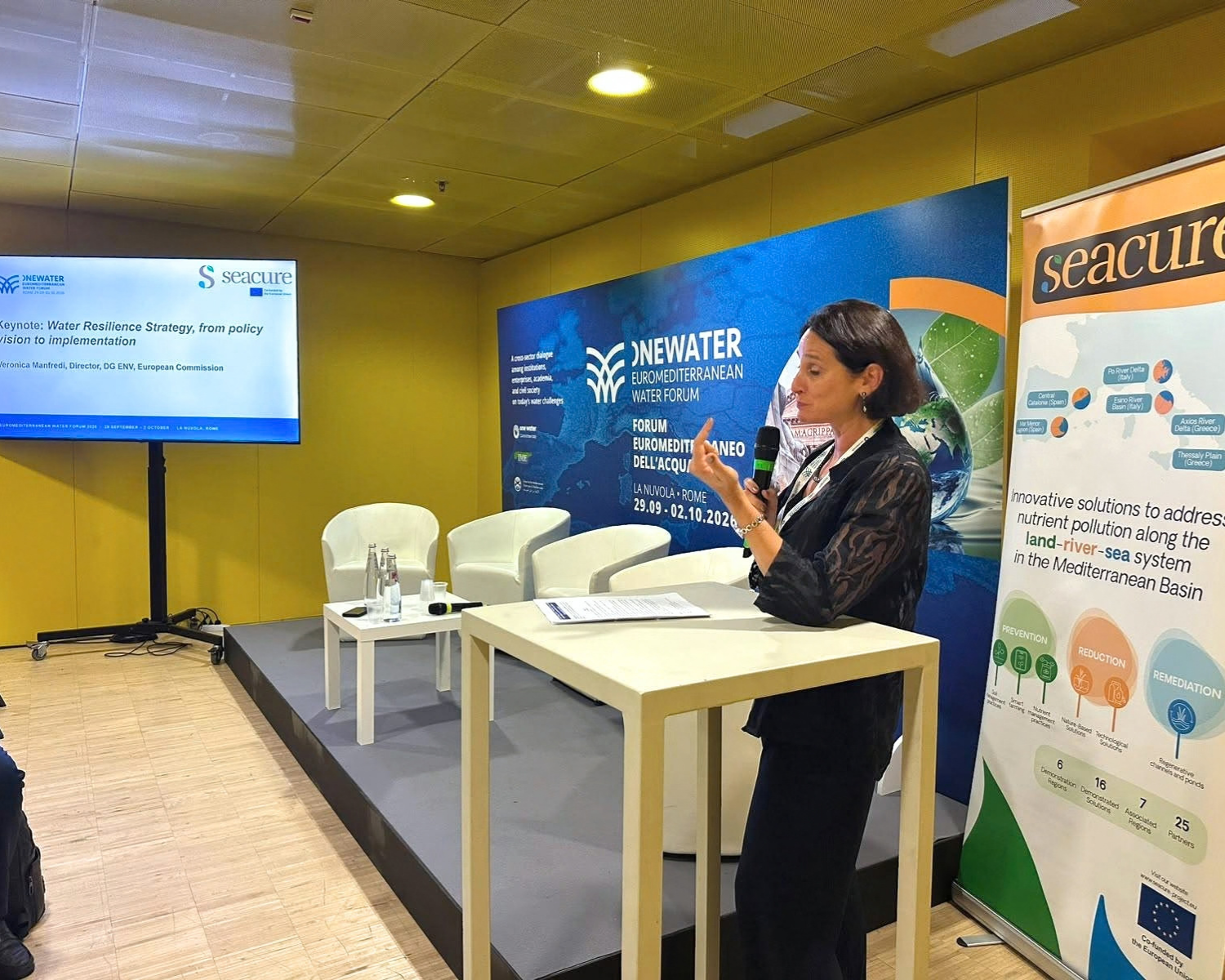
Veronica Manfredi, Director at DG Environment, European Commission, then delivered a keynote on the European Water Resilience Strategy and the shift from policy vision to implementation. Her active participation in the subsequent exchange helped connect the European policy framework with the practical challenges and opportunities encountered when implementing solutions on the ground.
Together, these contributions framed the wider European policy context for the discussion that followed: how approaches already demonstrating results at local and regional level can be replicated more widely, and what governance conditions are needed to support that transition.
Nutrient pollution requires integrated action across the land–river–sea continuum
Presenting SEACURE’s work, Lorenzo Proia, SEACURE Coordinator from BETA Technological Centre, highlighted the importance of looking at nutrient flows across the whole system rather than addressing individual pressures separately. This reflects SEACURE’s mission to connect prevention, reduction and remediation measures across the land–river–sea continuum and support their wider application across Mediterranean territories.
Building on this systemic perspective, the roundtable brought together actors from across the water governance and implementation landscape to examine what is needed to move from demonstration to wider application.
The discussion included contributions from:
- Mario Sprovieri, Director of Consiglio Nazionale delle Ricerche – Istituto di Scienze Marine (CNR-ISMAR)
- Paolo Mancin, Head of the Water Protection Department, Regione Piemonte
- Chiara Sarti, R&D Specialist, IRIDRA
- Martina Berneschi, Consorzio di Bonifica Pianura di Ferrara
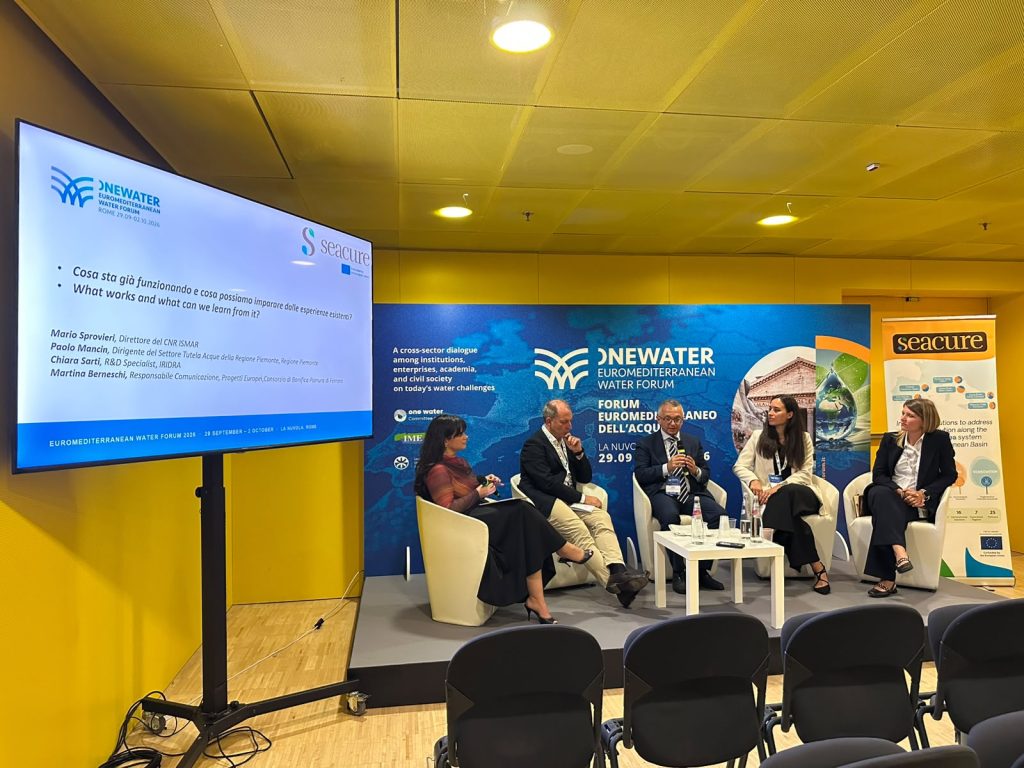
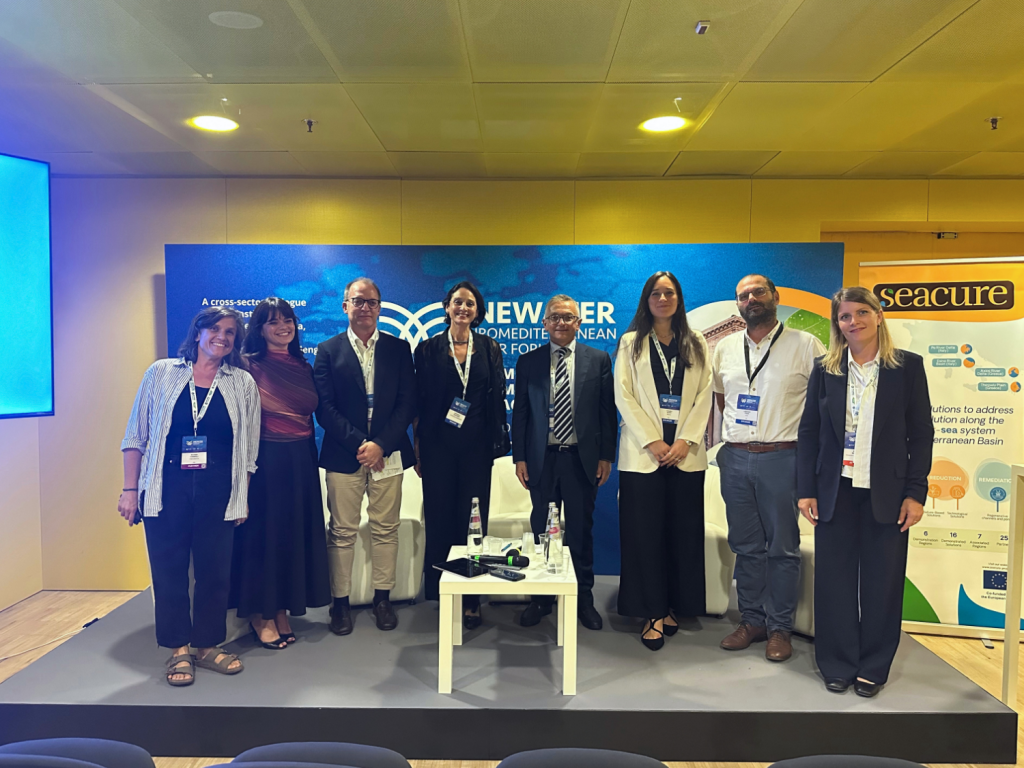
Together, they connected research, regional policy, technology development and day-to-day water management around the question of why nutrient pollution requires integrated governance.
A central message emerging from the discussion was the need for a coherent policy framework capable of connecting action across local, regional, national and European levels. Effective solutions and good practices already exist, but stronger mechanisms are needed to facilitate their exchange, replication and uptake across different territories and along the full land–river–sea continuum.
This is particularly important because managing nutrient flows from source to sea requires connecting solutions across the whole system and involving the relevant actors from the outset.
From evidence to policy and implementation
From nutrient recovery and reuse to nature-based solutions, scaling up is therefore not only a technical challenge. It depends on science, engineering, policy and governance working together, alongside regulatory fit, financing, institutional responsibilities, operational capacity and coordination across sectors. For nutrient management, strengthening dialogue between the actors involved in different parts of the system is critical.
Sessions like this provide an important bridge between scientific evidence from demonstration activities, on-the-ground implementation challenges and opportunities, and the policy frameworks needed to support wider action. They strengthen the science-policy interface by creating space to exchange experience across territories and to connect European policy objectives with the realities of implementation, ultimately helping move towards more effective action for healthier Mediterranean waters.
The exchange in Rome will continue to inform SEACURE’s work on the governance and enabling conditions needed to scale effective strategies across the Mediterranean land-river-sea continuum.